
What Is the Law for Changing Lanes in Oklahoma? Guide (2026)
Changing lanes is something most drivers do every day. Whether you are passing a slower vehicle, preparing for a turn, or avoiding road work, changing lanes is a normal part of driving. However, many drivers do not realize that Oklahoma has specific laws that control when and how you can change lanes.
Following these rules is important because an unsafe lane change can lead to traffic tickets, accidents, injuries, and higher insurance costs. Learning the law also helps you become a safer driver and avoid common mistakes on busy roads.
In this guide, you’ll learn what Oklahoma law says about changing lanes, when you can legally move into another lane, how to signal correctly, and the safest way to complete a lane change.
Understanding Oklahoma’s Lane Change Law
Oklahoma’s lane change law is found in Title 47, Section 11-309 of the Oklahoma Statutes. This law applies to roads that have two or more clearly marked lanes traveling in the same direction.
The law says that drivers should stay completely inside one lane whenever possible. You should not drift between lanes or move from one lane to another without a good reason. Before changing lanes, you must make sure it is safe and give other drivers enough warning by using your turn signal.
The purpose of this law is simple. Every driver should know what other vehicles are doing. Sudden lane changes without warning can surprise nearby drivers and increase the risk of crashes.
Instead of changing lanes whenever you feel like it, Oklahoma expects drivers to make careful and safe decisions. Even a small mistake while changing lanes can cause a serious accident, especially on highways where vehicles travel at higher speeds.
When Are Drivers Allowed to Change Lanes?
Oklahoma law allows drivers to change lanes only when two important conditions are met.
First, you must make sure that changing lanes can be done safely. This means checking the traffic around you and making sure there is enough space in the lane you want to enter.
Second, you must use your turn signal before moving into the next lane. Your signal tells other drivers what you plan to do so they have time to react.
For example, imagine you are driving on Interstate 35 behind a slow-moving truck. Before moving into the left lane, you should check your mirrors, look over your shoulder to check your blind spot, turn on your signal, and then carefully move into the next lane when it is safe.
If another vehicle is already close to you or moving quickly in the lane you want to enter, you should wait. There is no need to rush. Waiting a few extra seconds is always safer than forcing your way into traffic.
Remember, changing lanes is a decision that should only be made when it can be completed without putting yourself or other drivers in danger.
What Does “Safe to Move” Mean Under Oklahoma Law?
One of the most important parts of Oklahoma’s lane change law is making sure that your movement can be made safely.
In simple terms, this means checking everything around your vehicle before moving into another lane. Do not assume the lane is clear just because you looked a few seconds ago. Traffic conditions can change quickly.
Before changing lanes, you should:
- Check your rearview mirror.
- Check both side mirrors.
- Look over your shoulder to check your blind spot.
- Watch the speed of nearby vehicles.
- Make sure there is enough room between your vehicle and others.
Blind spots deserve special attention because mirrors cannot show every area around your vehicle. A motorcycle or small car may be hidden beside you without you noticing it in your mirrors.
For example, if a car is driving just behind your rear bumper in the next lane, moving over too soon could cause a collision. Even if your mirrors look clear, checking your blind spot can prevent this type of accident.
As the driver changing lanes, you are responsible for making sure the move is safe. If there is any doubt, wait until you have a better opportunity.
Turn Signal Requirements for Changing Lanes in Oklahoma
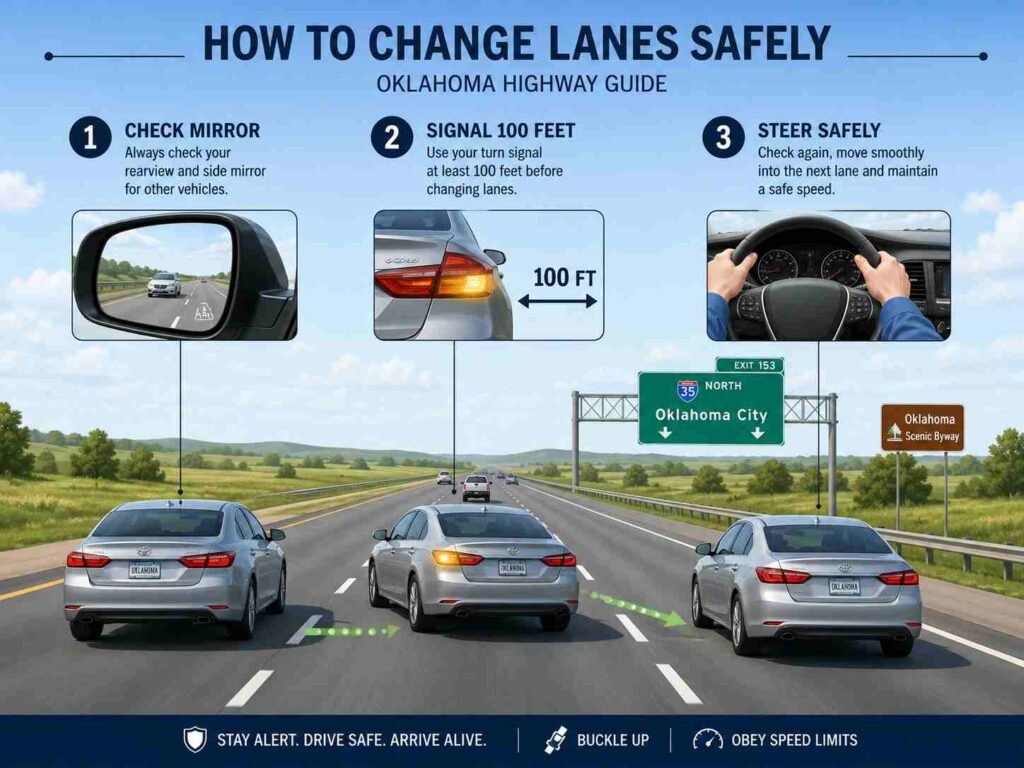
Using your turn signal is not just good driving manners—it is required by Oklahoma law.
Before changing lanes, you must signal your intention for at least the last 100 feet before moving your vehicle. This gives other drivers enough time to understand what you plan to do.
Many drivers wait until they are already moving into another lane before using their signal. This is incorrect and could result in a traffic violation.
If you are wondering how far 100 feet is, it is roughly the length of six to seven average passenger cars parked end to end. At normal city driving speeds, this usually means your turn signal should blink several times before you begin changing lanes.
Your signal should stay on during those 100 feet. Turning it on for only one quick flash does not provide enough warning to other drivers.
Even if the road seems empty, you should still use your signal. Another vehicle, cyclist, or motorcycle may be nearby without you noticing. Making signaling a habit helps you stay safe in every driving situation.
How to Change Lanes Legally in Oklahoma
Changing lanes safely only takes a few seconds, but every step matters. Following the correct process helps you stay within the law and reduces the chance of an accident.
Here is the safest way to change lanes in Oklahoma.
Check Mirrors and Blind Spots
Before doing anything else, look at your surroundings.
Start by checking your rearview mirror to see the traffic behind you. Next, check both side mirrors to understand where nearby vehicles are located.
After checking your mirrors, quickly look over your shoulder toward the lane you want to enter. This helps you see vehicles that may be hidden in your blind spot.
Skipping this final check is one of the biggest reasons lane change accidents happen. A quick glance over your shoulder only takes a second but can prevent a serious collision.
If another vehicle is beside you or approaching quickly, stay in your lane until it is safe.
Signal Before Changing Lanes
Once you know the lane is clear, turn on your signal.
Remember that Oklahoma requires drivers to signal for at least 100 feet before changing lanes. This gives everyone around you enough time to understand your next move.
Keep your signal on while you prepare to move. If another driver speeds up or enters the lane, simply wait until the lane is clear again.
Never assume another driver will automatically let you merge. Your signal tells others what you want to do, but it does not give you the right to move into an unsafe space.
Good communication between drivers makes the road safer for everyone.
Move Into the New Lane Safely
After checking your mirrors, confirming your blind spot is clear, and signaling for the required distance, you can begin moving into the new lane.
Steer smoothly instead of making a sudden movement. A gradual lane change gives you better control of your vehicle and makes your actions easier for other drivers to predict.
Once your vehicle is completely inside the new lane, straighten your steering wheel and turn off your signal if it has not already turned off automatically.
Continue driving at a safe speed that matches the flow of traffic. Avoid braking suddenly after changing lanes unless it is necessary to avoid a hazard.
By following these simple steps every time you change lanes, you can drive more safely, reduce the risk of accidents, and stay in compliance with Oklahoma traffic laws.
Common Lane Change Violations in Oklahoma
Many drivers receive traffic tickets because they do not follow basic lane change rules. Some violations happen because drivers are distracted, while others happen because they are in a hurry. Knowing the most common mistakes can help you avoid them.
One of the most common violations is changing lanes without using a turn signal. Even if the road looks empty, Oklahoma law still requires you to signal before moving into another lane. Another common mistake is changing lanes without checking mirrors and blind spots. This can lead to crashes with vehicles that are difficult to see.
Weaving through traffic is another unsafe driving behavior. This happens when a driver moves back and forth between lanes to get ahead of other vehicles. Frequent or unnecessary lane changes increase the risk of accidents and may result in a traffic citation.
Some drivers also drift across lane markings because they are distracted by their phone, food, or other activities inside the vehicle. Staying focused on the road helps you remain in your lane and avoid unnecessary violations.
Motorcyclists should also know that lane splitting is not legal in Oklahoma. Riding a motorcycle between two lanes of moving traffic is considered unsafe and is not permitted under state law.
Penalties for Unsafe Lane Changes in Oklahoma
Breaking Oklahoma’s lane change law can lead to more than just a warning. Depending on the situation, you may receive a traffic ticket, pay a fine, or have points added to your driving record.
The exact fine may vary by city or county, but an improper lane change can result in a financial penalty. Traffic violations can also affect your insurance rates because insurance companies often view moving violations as a sign of higher driving risk.
In many cases, an improper lane change adds 2 points to your Oklahoma driving record. If you continue to collect points from multiple traffic violations, you could eventually face a driver’s license suspension.
The consequences become much more serious if your unsafe lane change causes an accident. If another person is injured or property is damaged, you may also be responsible for repair costs, medical expenses, or other legal claims.
Following the law is much easier and much less expensive—than dealing with the results of an avoidable crash.
Situations Where Extra Caution Is Required
Some driving situations require even more attention than normal. Heavy traffic, high-speed highways, and work zones leave less room for mistakes, so changing lanes safely becomes even more important.
Taking a few extra seconds to observe traffic and plan your movement can help prevent accidents in these challenging conditions.
Changing Lanes on Highways and Interstates
Changing lanes on highways requires extra care because vehicles are traveling at much higher speeds than on city streets.
When driving on an interstate, always check your mirrors and blind spots carefully before moving into another lane. Vehicles approaching from behind may be traveling much faster than you expect.
Oklahoma also has rules about using the left lane on many highways and turnpikes. In general, the left lane is intended mainly for passing slower vehicles. After completing your pass, you should move back into the right lane when it is safe to do so.
Avoid staying in the left lane longer than necessary, especially if you are slowing down faster-moving traffic behind you.
Keeping a steady speed and leaving enough space between vehicles makes highway lane changes much safer.
Changing Lanes in Heavy Traffic or Construction Zones
Heavy traffic often means smaller gaps between vehicles. Instead of forcing your way into another lane, wait patiently for a safe opening.
Trying to squeeze into a small space can surprise other drivers and increase the chance of a collision. A little patience can prevent a serious accident.
Construction zones deserve even more caution. Road workers, temporary lane closures, and changing traffic patterns make these areas more dangerous than normal roads.
If you see emergency vehicles, tow trucks, or utility vehicles stopped with flashing lights, Oklahoma’s Move Over Law may require you to change lanes if it is safe to do so. If changing lanes is not possible, you must slow down and proceed carefully.
Always stay alert, reduce your speed when necessary, and follow any temporary traffic signs in construction areas.
Tips to Avoid Lane Change Accidents and Traffic Citations
Safe lane changes are built on good driving habits. By following a few simple tips every time you drive, you can lower your risk of accidents and avoid unnecessary traffic tickets.
Here are some helpful habits to practice:
- Always use your turn signal before changing lanes.
- Signal for at least 100 feet before moving.
- Check all mirrors before changing lanes.
- Look over your shoulder to check your blind spot.
- Avoid distracted driving, including texting or using your phone.
- Leave enough space between your vehicle and others.
- Change lanes smoothly instead of making sudden movements.
- Avoid weaving through traffic to save only a few seconds.
- Stay patient during heavy traffic.
- Follow the speed limit and adjust your speed to match traffic conditions.
These simple habits can make every trip safer for you, your passengers, and everyone sharing the road.
Frequently Asked Questions
1. Do I have to use my turn signal if no other cars are around?
Yes. Oklahoma law requires you to use your turn signal before changing lanes, even if the road appears empty. Signaling is a legal requirement and helps ensure everyone on the road understands your intentions.
2. How far before changing lanes should I signal?
You must signal for at least 100 feet before beginning your lane change. This gives nearby drivers enough time to react safely.
3. Can I change lanes inside an intersection?
Oklahoma law does not specifically ban changing lanes in every intersection, but it is generally safer to avoid doing so. If possible, complete your lane change before entering the intersection or wait until you have passed through it.
4. Is lane splitting legal in Oklahoma?
No. Lane splitting, where a motorcycle rides between lanes of moving traffic, is not legal in Oklahoma.
5. Can I be ticketed for weaving through traffic?
Yes. Frequently moving from lane to lane without a valid reason can be considered unsafe driving. Weaving through traffic increases the risk of accidents and may result in a traffic citation.
6. What happens if my unsafe lane change causes an accident?
If your lane change causes a collision, you may receive a traffic citation and could also be held responsible for injuries, property damage, or other legal costs, depending on the circumstances.
7. Is the left lane only for passing in Oklahoma?
On many highways and turnpikes, the left lane is mainly intended for passing slower vehicles. After passing, drivers should return to the right lane when it is safe to do so.
8. How can I avoid getting a lane change ticket?
The best way to avoid a citation is to follow the law every time you change lanes. Check your mirrors and blind spots, signal for at least 100 feet, make sure the lane is clear, and move over smoothly without cutting off other drivers.
Conclusion
Changing lanes safely is one of the most important skills every Oklahoma driver should master. State law requires you to stay within your lane whenever possible, signal for at least 100 feet before changing lanes, and make sure the move can be completed safely. These rules are designed to reduce accidents and help traffic flow smoothly.
Before every lane change, take a few extra seconds to check your mirrors, look over your shoulder for vehicles in your blind spot, and signal your intentions early. Avoid sudden movements, stay patient in heavy traffic, and never weave between lanes to save time. By following Oklahoma’s lane change laws and practicing safe driving habits, you can protect yourself, avoid traffic citations, and make the roads safer for everyone.