
What Is Double Jeopardy in Law? How It Works in Criminal Cases
Double jeopardy is a legal principle that protects people from being prosecuted or punished more than once for the same criminal offence after a final decision has been reached. In simple terms, if someone has already been acquitted or convicted of a crime, the government generally cannot put that person on trial again for the same offence. This rule is considered a cornerstone of a fair justice system because it helps prevent repeated legal action against the same individual.
Understanding what is double jeopardy in law is important for anyone interested in criminal justice or legal rights. Although the exact rules differ between countries, the underlying goal remains the same: to balance the government’s power to prosecute crimes with the individual’s right to fairness. At the same time, double jeopardy does not prevent every future legal action. There are exceptions and legal tests that determine whether a second prosecution is truly for the same offence.
Understanding What Double Jeopardy in Law Means
Double jeopardy is a legal safeguard that limits the state’s ability to prosecute a person repeatedly for the same criminal act. Once a court reaches a final judgment—whether it is a conviction or an acquittal the matter is usually considered settled. This protection reduces the risk of unfair treatment and gives people confidence that legal decisions have lasting effect. Without such a rule, prosecutors could continue bringing the same charges until they obtained a favourable verdict.
It is also important to understand what double jeopardy does not cover. The principle generally applies to criminal cases rather than civil disputes. For example, someone found not guilty of a criminal offence may still face a separate civil lawsuit if the law allows it. Likewise, a retrial may be possible if the original proceedings ended without a final verdict, such as when a mistrial is declared because the jury could not reach a unanimous decision.
The Origin and Evolution of Double Jeopardy
The idea behind double jeopardy has existed for centuries and reflects the belief that justice should be both fair and final. Ancient legal systems recognised that people should not be endlessly prosecuted for the same accusation. Over time, this concept became part of English common law and later influenced legal systems in many other countries, including the United States, Canada, Australia, and several Commonwealth nations.
As criminal justice systems developed, lawmakers refined the rules to address more complex legal situations. Modern courts now consider factors such as separate jurisdictions, different criminal charges, and constitutional protections before deciding whether double jeopardy applies. While the exact legal standards vary by country, the fundamental purpose remains protecting individuals from repeated prosecutions while allowing the justice system to correct genuine legal errors through appeals and other lawful procedures.
Early Roots in English Common Law
The principle of double jeopardy has deep roots in English common law, where judges recognised that individuals should not face repeated trials for the same alleged offence. This concept became part of the broader tradition of protecting personal liberty and limiting the government’s authority. English courts viewed repeated prosecutions as unfair because they exposed defendants to unnecessary stress, expense, and the constant risk of punishment.
Over the centuries, legal scholars and judges expanded these protections through court decisions rather than written statutes alone. These common law principles eventually influenced legal systems throughout the British Empire and beyond. Even today, many countries continue to rely on these historical foundations when interpreting modern criminal procedure and defendants’ rights.
How the Rule Developed in the United States
In the United States, double jeopardy became a constitutional protection through the Fifth Amendment to the U.S. Constitution. It states that no person shall “be subject for the same offence to be twice put in jeopardy of life or limb.” This clause protects individuals from multiple prosecutions, repeated punishments, and repeated attempts by the government to secure a conviction after an acquittal.
The interpretation of this constitutional protection has evolved through decades of Supreme Court decisions. Courts have clarified when jeopardy officially begins, how appeals affect the rule, and how it applies when both state and federal governments become involved in a case. These rulings have shaped modern American criminal law while reinforcing the importance of fairness and finality within the legal system.
How Double Jeopardy Protects Defendants
One of the greatest strengths of the double jeopardy rule is that it prevents government authorities from repeatedly prosecuting someone simply because they were dissatisfied with the first outcome. Without this protection, prosecutors could continue filing the same charges until they eventually obtained a conviction. Such a system would place enormous financial, emotional, and psychological pressure on defendants, even if they had done nothing wrong.
The rule also strengthens public confidence in the justice system by ensuring that court decisions carry legal weight. Once a person has been lawfully acquitted or convicted, they can generally move forward without fearing endless legal battles over the same offence. This balance protects individual rights while encouraging prosecutors to prepare strong cases before bringing criminal charges rather than relying on multiple attempts to achieve a desired result.
When Double Jeopardy Applies in Criminal Cases
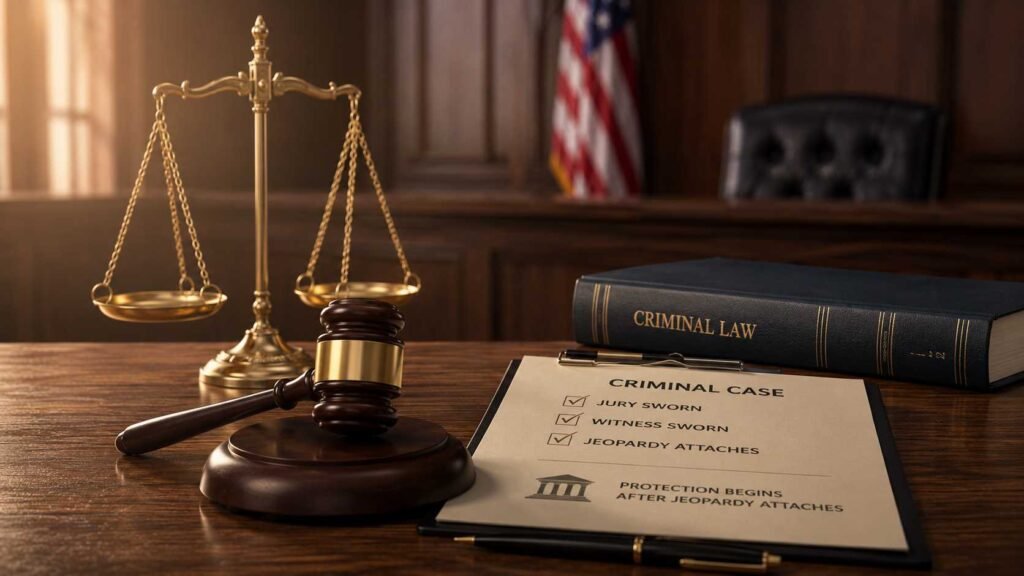
Double jeopardy does not apply the moment someone is arrested or charged with a crime. In most legal systems, the protection begins only after “jeopardy attaches,” which usually happens when a jury is sworn in during a jury trial or when the first witness is sworn in during a bench trial. From that point onward, certain constitutional protections prevent the government from trying the defendant again for the same offence after a final judgment.
However, not every criminal proceeding ends in a way that triggers double jeopardy. For example, if a judge declares a mistrial because the jury cannot reach a unanimous verdict, the prosecution may often retry the case. Likewise, if a defendant successfully appeals a conviction due to legal errors during the trial, a new trial may be allowed because the original conviction has been set aside rather than becoming final.
What Counts as the Same Offence?
One of the most challenging questions in criminal law is determining whether two charges involve the “same offence.” Simply because two charges arise from the same incident does not automatically mean double jeopardy applies. Courts examine the legal elements of each offence rather than focusing only on the facts of the case.
For instance, a single event may lead to multiple criminal charges if each offence requires proof of a different legal element. A person involved in a robbery that results in serious injury might face separate charges for robbery and aggravated assault because each crime contains distinct legal requirements. Courts carefully analyse these differences before deciding whether a second prosecution is prohibited.
The Blockburger Test Explained
One of the most widely recognised legal standards for determining whether two offences are legally the same is the Blockburger Test, established by the United States Supreme Court. Under this test, courts compare the legal elements of each offence instead of simply looking at the conduct involved. If each offence requires proof of at least one fact or element that the other does not, they are generally treated as separate offences.
For example, suppose a person is charged with burglary and possession of stolen property arising from the same incident. Although the events are connected, the prosecution must prove different legal elements for each charge. Because the offences are legally distinct, the Blockburger Test may allow both charges without violating double jeopardy protections.
Other Legal Standards Courts May Apply
Although the Blockburger Test is highly influential, courts do not rely on it in every situation. Different jurisdictions have developed additional legal principles to determine whether a later prosecution is fair and lawful. Some courts also consider legislative intent, asking whether lawmakers intended separate punishments for related offences arising from the same criminal conduct.
Courts may also examine whether an issue has already been fully decided in an earlier trial. In some cases, the principle known as collateral estoppel prevents prosecutors from relitigating factual issues that were previously resolved in the defendant’s favour. These additional safeguards help ensure that defendants receive meaningful protection while allowing legitimate criminal prosecutions to proceed when legally justified.
Can Someone Be Tried Again if New Evidence Is Found?
Many people assume that discovering new evidence automatically allows prosecutors to reopen a criminal case, but that is generally not how double jeopardy works. If a defendant has been acquitted after a valid trial, the discovery of stronger evidence—including DNA evidence or a confession from another person usually does not permit a second prosecution for the same
offence. The principle of finality remains one of the strongest protections within criminal law.
There are, however, limited exceptions in some countries. Certain jurisdictions have introduced laws allowing retrials for the most serious crimes when compelling new evidence becomes available and strict legal conditions are satisfied. These exceptions are carefully regulated and typically require approval from higher courts to ensure that retrials remain rare and do not undermine the purpose of double jeopardy protections.
Common Examples of Double Jeopardy in Law
A common example involves a defendant who is charged with theft and is found not guilty after a full trial. If prosecutors later decide to file the exact same theft charge based on the same facts because they believe they can present a stronger case, double jeopardy would generally prevent the second prosecution. The acquittal is considered final, and the government does not get another opportunity simply because it is unhappy with the verdict.
Another example involves multiple punishments. Suppose a person is convicted of a crime and receives the legally authorised sentence. The government generally cannot later impose an additional criminal punishment for the same offence after the sentence has become final. On the other hand, double jeopardy usually does not stop separate civil proceedings, disciplinary actions by professional licensing bodies, or prosecutions by a different sovereign in jurisdictions where the dual-sovereignty doctrine applies. These distinctions show why understanding the specific facts and applicable law is essential in every case.
Why Double Jeopardy Matters in the Justice System
Double jeopardy is one of the most important safeguards in criminal law because it protects individuals from repeated prosecution by the government. Without this protection, prosecutors could continue bringing the same case until they eventually secured a conviction. This would place an unfair burden on defendants, forcing them to spend time, money, and emotional energy defending themselves over and over again.
The principle also supports public confidence in the legal system. When courts reach a final decision after a fair trial, both defendants and society can rely on that outcome. Finality encourages careful investigations and thorough prosecutions while ensuring that the government cannot misuse its authority. In this way, double jeopardy helps maintain a balance between protecting the rights of individuals and enforcing criminal law.
How Double Jeopardy Works Across Federal and State Courts
In the United States, double jeopardy becomes more complicated when both federal and state governments have authority over the same conduct. Under the dual-sovereignty doctrine, the federal government and each state are considered separate sovereigns. This means that, in some situations, both may prosecute a person for offences arising from the same act without violating the Double Jeopardy Clause.
For example, a crime involving illegal firearms may violate both state law and federal law. A state prosecution does not always prevent a later federal prosecution because each government is enforcing its own laws. However, these situations are relatively uncommon and often involve serious offences. Other countries may follow different legal approaches, so the application of double jeopardy depends on the laws of the relevant jurisdiction.
Situations Where Double Jeopardy Does Not Apply
Although double jeopardy provides strong legal protection, it does not apply to every legal proceeding. One common exception occurs when a trial ends in a mistrial due to a hung jury. Because no final verdict has been reached, prosecutors are generally allowed to retry the case. Similarly, if a defendant successfully appeals a conviction because of significant legal errors during the trial, a new trial may often be held.
Double jeopardy also does not usually prevent civil lawsuits based on the same events. For example, someone acquitted of assault in criminal court may still face a civil claim for damages filed by the alleged victim. In addition, separate offences with different legal elements, prosecutions by separate sovereign governments in some jurisdictions, and certain administrative or disciplinary proceedings may fall outside the protection offered by double jeopardy.
When to Speak With a Criminal Defence Lawyer About Double Jeopardy
Anyone who believes they are facing criminal charges for an offence that has already been resolved should speak with a qualified criminal defence lawyer as soon as possible. A lawyer can review previous court records, examine whether a final judgment exists, and determine if double jeopardy protections may apply. Acting early can be important because legal arguments often need to be raised before the trial proceeds.
Legal advice is especially valuable when cases involve multiple jurisdictions, appeals, mistrials, or complicated charging decisions. Criminal law varies from one country to another, and even experienced individuals may misunderstand how double jeopardy works in practice. A knowledgeable lawyer can explain the applicable law, protect the defendant’s rights, and guide them through the legal process.
Frequently Asked Questions
1. What is double jeopardy in law?
Double jeopardy is a legal rule that generally prevents someone from being prosecuted or punished more than once for the same criminal offence after a final judgment.
2. Does double jeopardy apply to civil cases?
No. Double jeopardy usually applies only to criminal proceedings. Civil lawsuits based on the same incident may still be allowed.
3. When does double jeopardy begin?
In most criminal cases, jeopardy begins when the jury is sworn in or, in a bench trial, when the first witness is sworn.
4. Can a person be retried after a mistrial?
Yes. If a mistrial is declared because no final verdict was reached, such as with a hung jury, a retrial is often permitted.
5. Can new evidence lead to another trial after an acquittal?
In most jurisdictions, no. A final acquittal generally prevents another prosecution for the same offence, even if new evidence is later discovered, although some countries recognise limited exceptions for very serious crimes.
6. What is the Blockburger Test?
The Blockburger Test helps courts determine whether two criminal charges are legally the same offence by comparing the legal elements required to prove each charge.
7. Can federal and state governments both prosecute the same act?
In the United States, they sometimes can under the dual-sovereignty doctrine because federal and state governments are separate sovereigns.
8. Why is double jeopardy important?
It protects individuals from repeated prosecutions, promotes fairness, preserves the finality of court decisions, and limits the government’s power in criminal cases.
Conclusion
Understanding what is double jeopardy in law is essential because it protects individuals from being prosecuted or punished more than once for the same criminal offence after a final judgment. This legal principle promotes fairness, prevents the misuse of prosecutorial power, and ensures that court decisions carry lasting value. While there are limited exceptions involving mistrials, appeals, or separate jurisdictions, double jeopardy remains a fundamental safeguard in many legal systems. If you are unsure whether it applies to a particular case, consulting a qualified criminal defence lawyer is the best way to understand your rights and the legal options available.